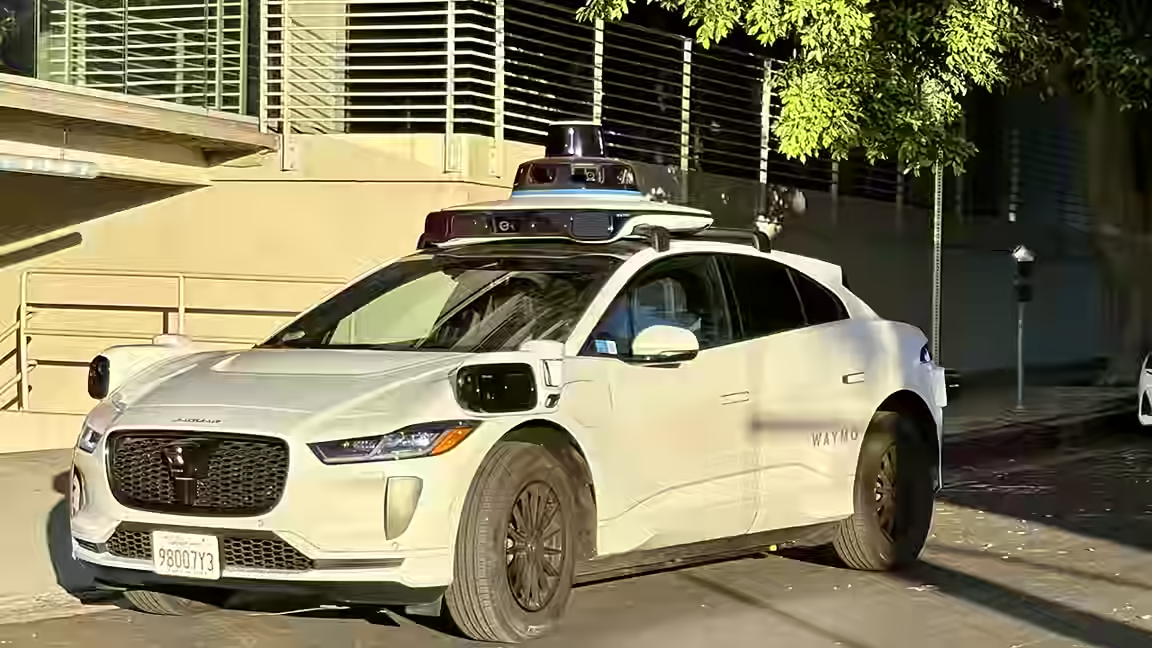
Waymo has outlined plans to bring its autonomous ride-hailing service to Singapore, starting with manually driven mapping and validation vehicles in 2027 and targeting a commercial opening in 2028. The company says each stage will require cooperation with Singapore’s Ministry of Transport, Land Transport Authority and other agencies, making the announced dates goals rather than unconditional launch commitments.
The initial fleet will use all-electric Jaguar I-PACE vehicles fitted with the fifth generation of the Waymo Driver. Human drivers will first map roads and collect data across Singapore. Waymo then plans to introduce autonomous operation with trained local specialists behind the wheel before seeking permission to remove the safety driver. The company says it expects testing to operate during the day and at night so the system can be assessed in different road and weather conditions.
Singapore presents a distinct environment for a system developed primarily on American roads. Dense urban traffic, left-side driving, tropical rain and a transport network built around buses and rail will all shape validation. Waymo says it intends the service to supplement rather than replace existing public transport and describes shared electric vehicles as part of the city-state’s wider sustainability and mobility plans. It also points to possible benefits for older people and residents who cannot drive.
The Waymo Driver combines lidar, cameras and radar to build a 360-degree view around each vehicle. According to the company, its sensors can detect objects as far as 300 metres away under appropriate conditions. Software uses those inputs to identify and respond to motorists, cyclists and pedestrians. Waymo says its technology has accumulated more than 300 million kilometres on public roads and billions more in simulation, although experience gathered elsewhere does not itself establish performance on Singapore’s streets.
The company currently offers public autonomous rides in several United States cities, including San Francisco, Los Angeles and Phoenix, and has also expanded testing to international cities such as Tokyo and London. It cites its United States collision data as evidence that fully autonomous operation can reduce injury-causing crashes relative to human-driving benchmarks in the same operating areas. Singapore regulators will make their own assessment before approving any comparable service locally.
Waymo says information gathered during Singapore testing will be processed under the country’s Personal Data Protection Act and its own services privacy policy. That issue is especially relevant for vehicles whose sensor arrays continuously observe public streets.
The phased schedule leaves several milestones between the announcement and paid driverless rides. Mapping must be completed, the driving system must be adapted and validated, and regulators must approve successive operating modes. Waymo has not presented the 2028 service date as permission already granted. Instead, the plan marks the beginning of a multi-year deployment process in one of Asia’s most closely managed transport markets.