Components allegedly replaced with older parts
A US Customs and Border Protection supervisor in Calais, Maine, has been arrested and charged with theft and damage to government property after investigators found hardware missing from computers at three border facilities. The allegations concern at least 46 Department of Homeland Security machines whose processors, memory or storage had been replaced.
The September 13 report identifies the accused as Terry “Jiajia” Liu, whose duties included information-technology support. A written instruction from the port director had barred Liu from moving computers or components, according to the affidavit summarized by Tom’s Hardware. Charges and investigative claims remain allegations unless proven in court.
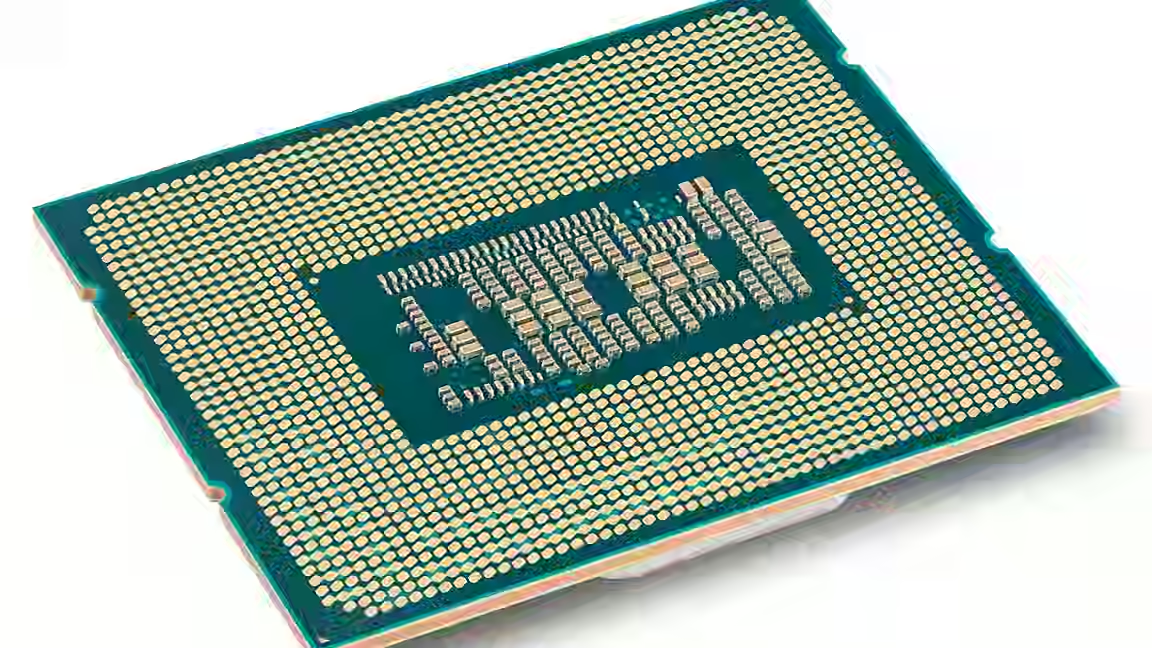
Investigators said 39 computers had different processors, six had memory modules exchanged and eight had hard drives changed. Some systems originally equipped with Intel 14th-generation Core i7 processors were found with substantially older chips, including Pentium models. Other machines had less memory or storage capacity than their documented configurations.
Hidden cameras installed during the inquiry allegedly recorded Liu opening government computers during overnight shifts, moving systems to a training room and exchanging components. One recording was described as showing thermal paste being scraped from a processor before another chip was installed. Another allegedly showed a memory module being removed and placed in a desk drawer.
Trade-in records formed part of the case
The affidavit links processors matching the missing government components to Newegg’s trade-in program. Investigators said 13 emails sent between a personal account and an official CBP address contained shipping labels and trade-in receipts. Transaction records allegedly showed 16 Core i7 trade-ins between May 2025 and July 2026, generally offered at $200 to $210 each. Three $200 Newegg credits also appeared in American Express records reviewed by investigators.
According to the reported affidavit, Liu admitted replacing parts in government computers with lower-performing components bought through Amazon and Newegg and submitting government-owned equipment for trade-in. The account says Liu initially offered an explanation involving repair delays and performance improvements, then acknowledged that the changes reduced performance. NeoTechNews has not independently reviewed a plea or court finding.
The estimated cost depends on how the government restores the machines. Replacing the removed components was put at about $20,460, while replacing all 46 affected computers with equivalent systems was estimated at $105,800. Those figures exclude additional labour needed to configure machines for government use.
The case illustrates how ordinary component swaps can create operational and evidentiary problems in managed computer fleets. It also raises potential data-handling concerns because drives were among the components reported changed, although the supplied evidence does not say that government information was accessed, copied or exposed. The criminal process will determine responsibility for the alleged theft and damage.