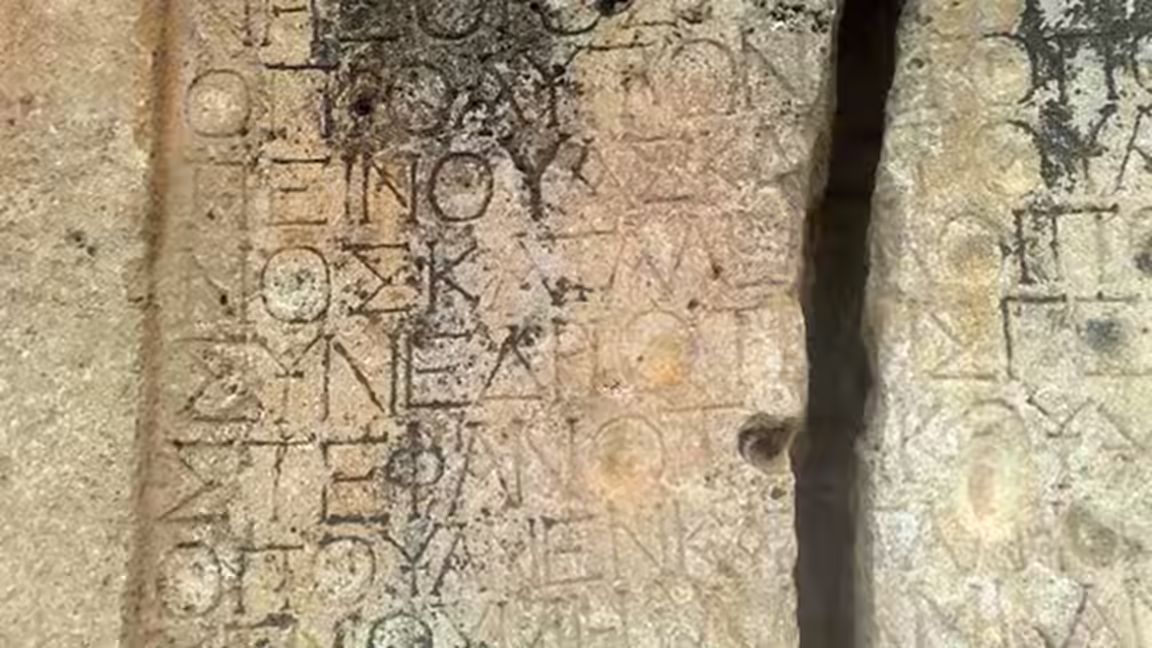
About 1,000 words in Ancient Greek cannot be securely traced to Proto-Indo-European or to another known neighboring language, according to a new overview of the evidence for the linguistic layer commonly called Pre-Greek. The vocabulary includes familiar terms and names that became central to Greek culture, yet their sound patterns and histories resist the family connections linguists use to reconstruct most Greek words.
The central explanation is language contact. Early Hellenic speakers entered an eastern Mediterranean already inhabited by farming societies whose languages belonged to an older European linguistic landscape. Those communities encountered new plants, animals, terrain and maritime life. Instead of inventing names for everything, incoming speakers could adopt words already used by local populations. As Greek eventually became dominant, the earlier languages disappeared while portions of their vocabulary remained embedded in Greek.
Linguists describe that relationship with the terms “superstrate” and “substrate.” A politically or socially dominant language forms the superstrate, while a displaced language supplies the substrate. The surviving borrowed vocabulary becomes a kind of historical record, even when the source language itself left little or no decipherable writing. This process is not unique to Greek, but the size and character of the unexplained Greek word stock give researchers a substantial body of material to examine.
Words for the sea illustrate the argument. Greek could adapt inherited Indo-European vocabulary: póntos, used for sea, came from a root meaning path or road, while háls primarily meant salt and could poetically denote the sea. The common word thálassa, however, has no widely accepted Indo-European etymology. That fits a broader migration pattern because Proto-Indo-European arose in an inland environment and has no securely reconstructed word for sea. Its descendant languages developed or borrowed their own coastal vocabulary as speakers reached maritime regions.
The same contact mechanism may explain Greek words for Mediterranean plants and other features unfamiliar to populations arriving from the Pontic-Caspian steppe. Olives, figs, hyacinths and cypresses are examples of objects for which local names could have been more useful than newly coined terms. The analysis contrasts such borrowing with transparent Greek inventions such as the description of a hippopotamus as a “river horse.”
The label Pre-Greek does not mean researchers have recovered a single complete language or identified every unexplained word with certainty. It is a working name for substrate material that predates Greek in the Aegean. Most Paleo-European languages vanished without extensive records; among the better attested examples are Etruscan and Iberian, while Basque is the only survivor identified in the overview.
The value of the evidence is therefore cumulative rather than dependent on one spectacular discovery. Recurring word shapes, clusters of terms tied to the local environment and the absence of convincing Indo-European relatives together preserve clues about communities whose speech otherwise went unrecorded.