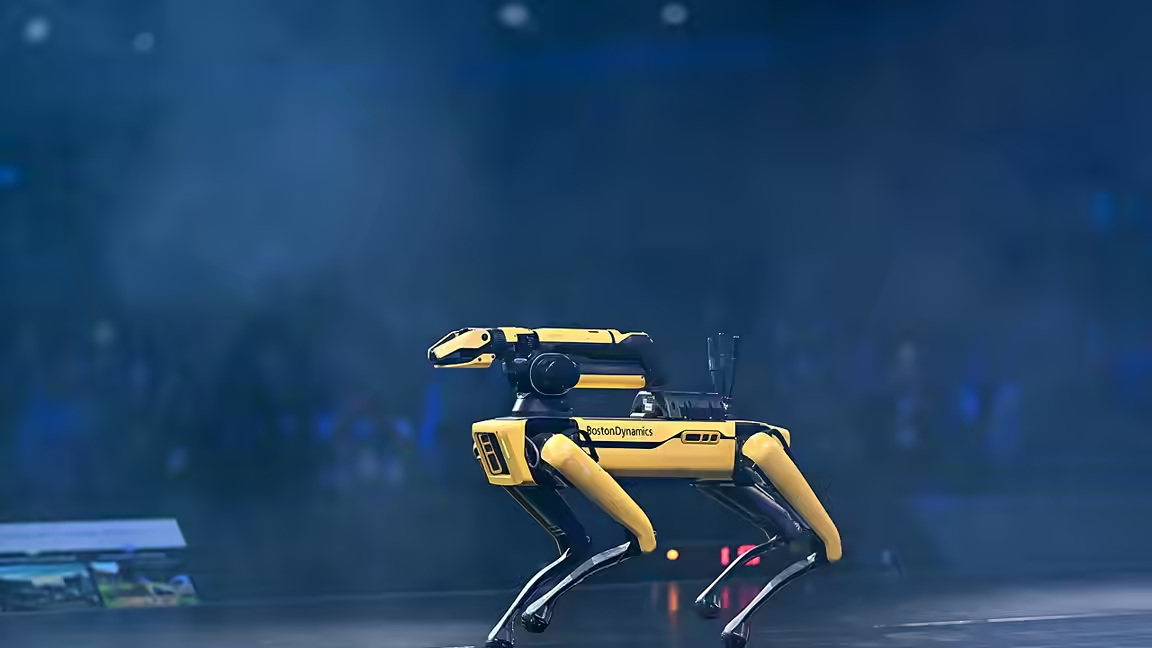
Employees challenge a government contract
Dozens of Boston Dynamics employees have asked the robotics company to halt a sale of its Spot quadruped robots to US Immigration and Customs Enforcement, according to a petition reported by WBUR. The disagreement places the company's internal ethics debate alongside a concrete federal contract for technology designed to enter difficult or dangerous spaces.
The $1.3 million agreement, settled in September, covers four Spot robots and related technology. Spot is a four-legged mobile machine equipped with cameras and sensors, allowing it to move through settings that may be awkward or hazardous for people. ICE has said the systems would provide situational awareness in confined, dangerous or tactically uncertain environments before officers enter. The agency also said the machines would not replace human judgment.
Employees sent their petition to company leaders in early September. Boston Dynamics confirmed its existence to WBUR. The company said nearly half of the petition's roughly 300 signatures were entered anonymously; Boston Dynamics employs more than 1,500 people. Staff members argued that proceeding could damage the company's reputation, unsettle workers and make recruitment harder. They also said public-facing teams had received messages expressing concern about the deal.
Leadership stands by the sale
Boston Dynamics says the customer is ICE's Homeland Security Investigations unit, whose work is focused primarily on transnational crime rather than immigration removals. That distinction did not resolve the employees' objection, which focused on the risk that association with ICE would conflict with how workers understand the company's mission and ethical commitments.
Interim chief executive Amanda McMaster told employees that the company had considered the petition but would continue with the transaction. She pointed to sales terms that prohibit weaponising the robot or using it to cause harm or intimidation, and asked staff to accept the decision even if they disagreed.
The company's published principles say it will take appropriate steps if its products are used to cause harm. The report did not establish what specific monitoring or enforcement measures would apply after delivery, leaving a practical question about how the restrictions would be supervised.
The dispute illustrates a recurring challenge for makers of increasingly capable mobile robots. A platform can be marketed as a way to reduce human exposure to danger while employees and the public still question which agencies should operate it and under what safeguards. Here, the immediate outcome is clear: leadership intends to proceed, while a substantial group of workers has formally recorded its opposition.